
A real estate agent coordinates the closing process by managing communication, deadlines, inspections, and paperwork across every party involved in the transaction. This coordination role is

Dated: June 21 2026
Views: 976

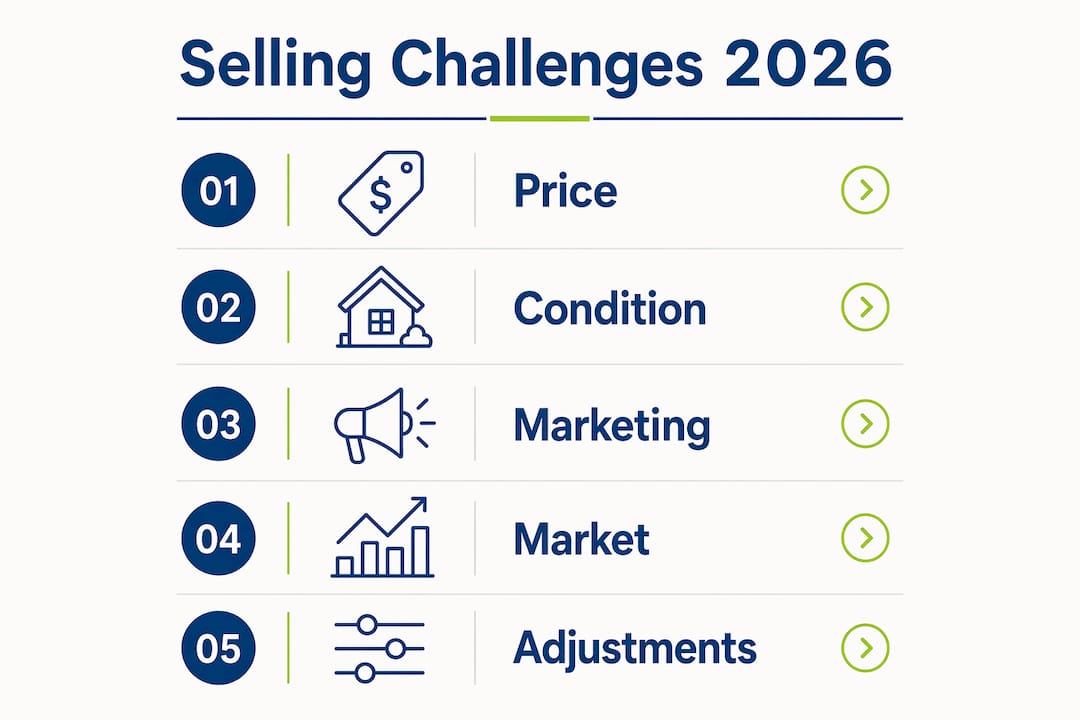
A home that won't sell is almost always the result of one or more of four fixable problems: price, condition, marketing, or market timing. Understanding why is my home not selling starts with separating emotion from evidence. Sellers in 2026 face a more demanding buyer pool, longer days on market, and higher expectations around presentation. The good news is that each of these obstacles has a clear, proven solution. This article breaks down every major reason homes stall on the market and gives you specific steps to turn your listing around.
Overpricing is the single most common reason a listing goes stale. Buyers today are well-informed. They compare your home against every comparable sale within seconds on Zillow, Redfin, or Realtor.com, and an inflated price sends them straight to the next listing. According to Redfin's analysis, overpricing by 10% or more can add more than a month to your time on market. That delay is costly because it signals to future buyers that something is wrong with the property.
A price-to-condition mismatch is a subtler but equally damaging problem. This happens when a home looks acceptable online but buyers discover deferred maintenance, dated finishes, or repair needs during a showing. Showings without offers almost always point to this exact mismatch. Buyers mentally adjust the price down to cover what they see as risk, and if your asking price doesn't reflect that reality, they walk.
Here is how to get your pricing right:
Pro Tip: Sellers who test pricing strategies and are willing to adjust quickly reduce time on market and avoid the stigma that comes with repeated price drops. One clean, well-researched reduction beats three small ones.
Buyers today expect well-maintained homes and generally avoid properties needing significant repairs unless the price reflects that work. This is not a preference. It is a pattern backed by buyer behavior data. A leaky faucet, scuffed baseboards, or a musty smell in the basement are not minor details to a buyer. They are signals that the home has not been cared for, and they raise questions about what else might be wrong.
The good news is that most condition issues are inexpensive to fix. Here is a practical pre-listing preparation checklist:
Pro Tip: Spend $200 to $400 on a pre-listing home inspection. Knowing your home's condition before buyers do gives you control over the narrative and eliminates surprises that kill deals at the inspection stage.

The lead photo carries the most weight. High-quality lead photos that focus on lifestyle and home strengths, such as a bright living room or a well-staged kitchen, consistently outperform generic wide-angle exterior shots in attracting buyer clicks. Photo sequencing also matters. Walk buyers through the home logically: exterior, entry, main living areas, kitchen, primary bedroom, bathrooms, and outdoor space. A disorganized photo gallery creates confusion and reduces engagement.
Beyond photography, your marketing reach determines how many buyers even see your listing:
Early listing activity such as views and shares signals relevance and influences ongoing buyer interest and search placement. If your listing has been live for two weeks with low click-through rates, the photos or the marketing distribution need to change immediately. Low early engagement is a clear signal that pricing or marketing adjustments are overdue.
The broader real estate market in 2026 is working against sellers in ways that were not present two years ago. Median days on market have increased approximately 14% year-over-year, reaching 66 days nationally as of February 2026. That number tells you that slower sales are not a personal failure. They reflect a market that has shifted toward buyers.
Elevated mortgage rates have reduced buyer purchasing power and urgency. A buyer who qualified for a $600,000 home in 2022 may only qualify for $480,000 today at current rates. That compression reduces the pool of qualified buyers for any given price point and gives those buyers more negotiating leverage.
| Market factor | Impact on sellers |
|---|---|
| Rising inventory | More competition per buyer, longer decision timelines |
| Higher mortgage rates | Smaller buyer pool, reduced urgency to act fast |
| Increased days on market | Buyers perceive more negotiating power |
| Price sensitivity | Buyers walk away faster from overpriced or dated homes |
Understanding these signals helps you set realistic expectations and make smarter decisions. If your local market has 4 or more months of inventory, you are in buyer's market territory. In that environment, price and condition must be sharper than ever because buyers have options. Sellers who recognize this early and adjust their strategy, rather than waiting for the market to shift back, consistently achieve better outcomes.
Separating your listing's performance into three diagnostic stages helps pinpoint the real problem. If online views are low, marketing is the issue. If views are high but showings are low, photos or pricing are the problem. If showings are frequent but offers are absent, a condition or price-to-condition mismatch is the culprit. This framework, drawn from NAR listing performance insights, removes the guesswork from diagnosing a stalled sale.
Homes that fail to sell share a predictable set of problems: overpricing, poor condition, weak marketing, and misaligned expectations about the current market.
| Point | Details |
|---|---|
| Price is the top barrier | Overpricing by 10% or more adds over a month to your time on market. |
| Condition shapes offers | Buyers avoid homes needing repairs unless the price reflects the work required. |
| Photos drive showings | 81% of buyers rely on listing photos to decide whether to schedule a visit. |
| Early momentum matters | Low views or showings in the first two weeks signal the need for immediate adjustments. |
| Market context is real | National days on market hit 66 days in February 2026, so patience must be paired with strategy. |
After working with sellers across Herndon, Reston, and Great Falls, I have noticed one pattern that repeats itself more than any other. Sellers wait too long to act on feedback. They receive three or four showing reports that all say the same thing, the price feels high for the condition, and they hold on for another three weeks hoping the right buyer shows up. That buyer rarely does.
The most damaging misconception I see is the belief that a price reduction signals weakness. It does not. It signals market awareness. Buyers and their agents respect sellers who respond to data. What actually damages your position is a listing that sits for 90 days with two price drops and a growing stigma. One well-timed, well-researched adjustment made in week three is worth more than three reactive cuts made in month three.
I also want to be honest about agent communication. If your agent is not giving you weekly showing feedback, updated market comparisons, and a clear opinion on what needs to change, that is a problem worth addressing directly. You deserve specific answers, not reassurance. The sellers I have seen succeed fastest are the ones who treat their listing like a product launch. They monitor the data, respond to feedback, and make decisions based on evidence rather than hope.
If you are asking why your house is not selling, the answer is almost always visible in the numbers. You just need someone willing to tell you the truth about what they mean.
— Mazin
If your listing has stalled, the fastest path forward is a conversation with someone who knows your specific market. Herndonhomeguide connects you directly with Mazin Abdelhameid, a local real estate expert serving Herndon, Reston, and Great Falls who specializes in pricing strategy, professional marketing, and preparation guidance for sellers.

Through Herndonhomeguide, you get access to a local market expert who will review your current listing, identify the specific obstacles holding back your sale, and build a targeted plan to fix them. Whether your home needs a pricing adjustment, better photos, or a pre-showing preparation strategy, Mazin brings the data and the direct feedback that turns stalled listings into closed sales. Reach out today for a personalized seller consultation.
After 30 days without an offer, the most likely causes are overpricing, weak listing photos, or a condition issue discovered during showings. Review your showing feedback and compare your price against recent closed sales in your area.
If you are getting showings but no offers, your price likely does not match what buyers see when they visit. Overpricing by 10% or more can add over a month to your time on market, so a comparative market analysis from a local agent is the fastest way to recalibrate.
Buyers prioritize cleanliness, condition, and the ability to visualize themselves living in the space. Decluttering, neutralizing odors, and completing visible repairs are the three highest-impact preparation steps before any showing.
The national median days on market reached 66 days as of February 2026, up approximately 14% from the prior year. Homes priced correctly and presented well in competitive markets can still sell faster than that average.
Yes. Since 81% of buyers rely on listing photos as their primary research tool, poor photography directly reduces the number of showings you receive. Strong marketing across MLS, social media, and agent networks compounds that impact.
A real estate agent coordinates the closing process by managing communication, deadlines, inspections, and paperwork across every party involved in the transaction. This coordination role is
What Does Real Estate Seasonality Mean for Buyers?Real estate seasonality is defined as the predictable annual cycle of fluctuations in buyer demand, home inventory, and prices that repeat at
Reston Homeowners Association: 2026 Resident GuideThe Reston Homeowners Association is the primary community organization governing property standards, amenities, and neighborhood rules for most
Work With a Buyer Agent Effectively in 2026A buyer's agent is defined as a licensed real estate professional who represents the buyer's legal and financial interests throughout the entire purchase
 © BRIGHT, All Rights Reserved
Information Deemed Reliable But Not Guaranteed
The data relating to real estate for sale on this website appears in part through the BRIGHT Internet Data Exchange program, a voluntary cooperative exchange of
property listing data between licensed real estate brokerage firms in which
participates, and is provided by BRIGHT through a licensing agreement.
The information provided by this website is for the personal,
non-commercial use of consumers and may not be used for any purpose other than to identify prospective properties consumers may be interested in purchasing.
Data last updated: September 21, 2026 8:07 AM UTC
Some properties which appear for sale on this website may no longer be available
because they are under contract, have Closed or are no longer being offered for sale.
Some real estate firms do not participate in IDX and their listings do not appear on this website. Some properties listed with participating firms do not appear on this website at the request of the seller.
Show More...
