
A real estate agent coordinates the closing process by managing communication, deadlines, inspections, and paperwork across every party involved in the transaction. This coordination role is

Dated: June 30 2026
Views: 331

Real estate seasonality is defined as the predictable annual cycle of fluctuations in buyer demand, home inventory, and prices that repeat at roughly the same time each year. These shifts are not random. They follow a consistent rhythm tied to weather, school calendars, and holiday cycles. Understanding what does real estate seasonality mean gives you a real edge, whether you are planning to list your home or searching for your next one. Prices typically run 2–5% below average in january and february, then climb to their highest point in may and june. Knowing that rhythm is the starting point for every smart timing decision.
The most direct impact of housing seasonality shows up in two numbers: sale price and days on market. Both move in a predictable arc across the calendar year.
Homes listed during the spring and summer sell 33–48% faster than those listed in winter. That speed translates directly into money. Listings that close in fewer than 30 days carry a 62% chance of closing at or above list price, compared to just 22% for homes sitting on the market over 60 days. The difference is not small. It is the gap between a bidding war and a price reduction.

The 90-day window from roughly late march through june is often called the "Spring Sprint." During this period, homes move in 31–33 days on average. Outside of it, that number climbs past 49 days. June is the single fastest month, with typical home turnover around 30 days and a price spike of approximately 3.9% above the annual average.
| Season | Avg. Days on Market | Price vs. Annual Average |
|---|---|---|
| January–February | 49+ days | 2–5% below average |
| March–April | 35–40 days | Near average |
| May–June | 30–33 days | 2–5% above average |
| July–August | 35–42 days | Slightly above average |
| November–December | 50+ days | 2–5% below average |
Pro Tip: If you are a seller, listing in late april rather than waiting until july can mean the difference between catching peak demand and chasing it. The Spring Sprint does not wait.
Every extra week a home sits on the market adds carrying costs: mortgage payments, taxes, insurance, and utilities. Investors and experienced agents calculate these costs precisely before deciding whether to wait for peak season or list immediately. For most sellers, the math favors spring.
"Seasonality is mainly linked to practical life events like school schedules and weather, making it a human-driven market rhythm rather than arbitrary fluctuations." — Deal Run
Regional climate amplifies or mutes all of these forces. A cold winter in Chicago makes the spring thaw feel like a starting gun. A mild winter in Phoenix barely registers as a slowdown at all.
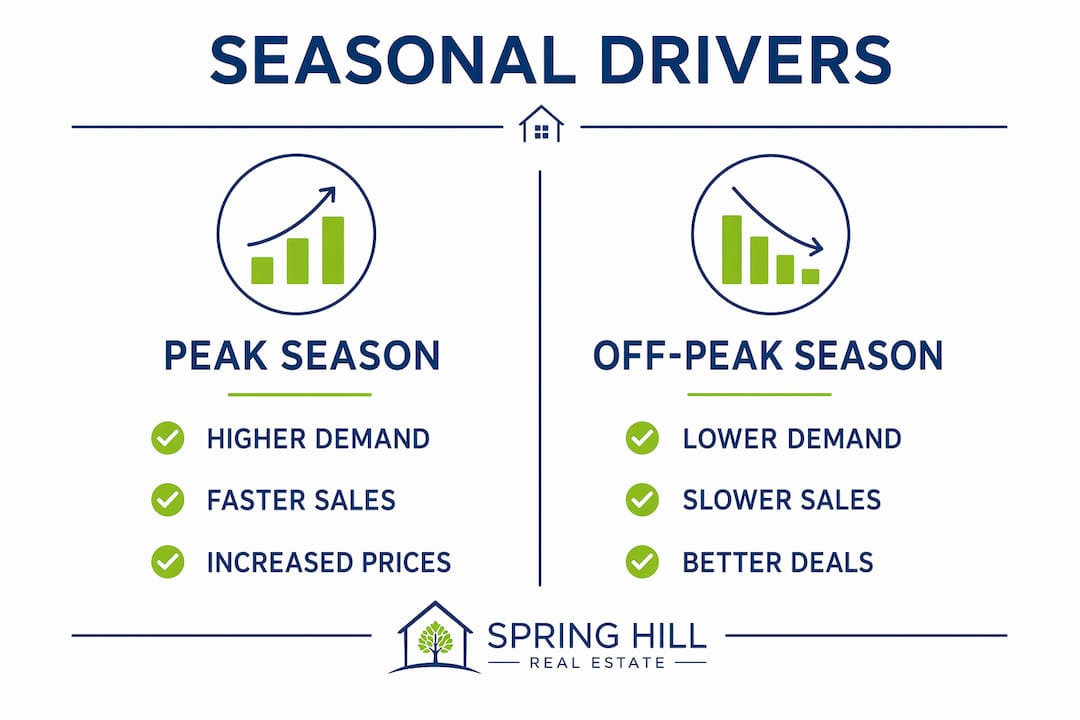
The traditional seasonal peak used to land in may and june. Post-pandemic data from 1991–2024 shows that peak activity has shifted earlier, to march and april in many markets. Remote work, early mortgage rate locks, and changed buyer behavior all contributed. If you are still planning around a june listing date, you may already be behind the curve in some markets.
Regional differences are just as significant as timing shifts. Colder Northeast and Midwest markets experience price swings of 8–12% from seasonal trough to peak. That is a substantial gap. Sun Belt markets in states like Florida, Texas, and Arizona see much steadier year-round activity, with milder swings and less pronounced off-peak slowdowns.
| Market Type | Seasonal Price Swing | Peak Activity Window | Off-Peak Slowdown |
|---|---|---|---|
| Northeast / Midwest | 8–12% trough to peak | March–June | Significant (Nov–Feb) |
| Sun Belt (FL, TX, AZ) | 2–4% trough to peak | Year-round, slight spring bump | Minimal |
| Pacific Northwest | 5–8% trough to peak | April–July | Moderate (Dec–Feb) |
The practical takeaway: a one-size-fits-all timing strategy misleads buyers and sellers. A february listing in Boston is a very different proposition than a february listing in Tampa. Always anchor your timing decisions to local data, not national averages.
Understanding real estate cycles is useful only if you act on the knowledge. Here is how to apply it on both sides of a transaction.
Sellers: list to catch the peak. Price your home and go live in late march or april to capture the Spring Sprint. Buyers are active, competition is high, and you are most likely to receive multiple offers. Waiting until july means competing with more inventory and fewer urgently motivated buyers.
Sellers: adjust your comps seasonally. If your agent pulls comparable sales from november or december to set your list price, those comps reflect a seasonal trough. Using off-peak comps without adjustment can undervalue your home by 4–8%. Ask for a seasonal adjustment of 2–5% when peak-season comps are not available.
Buyers: target winter for negotiating power. Winter listings carry longer days on market and more seller flexibility. Motivated sellers who need to relocate quickly or close before year-end are often willing to offer closing cost credits, price reductions, or upgrades that simply do not exist in a spring bidding war.
Buyers: watch for fall opportunities. September and october represent a second, smaller window of opportunity. Spring buyers who did not find a home are gone, inventory is still reasonable, and sellers who missed the summer peak are often more flexible on price.
Both sides: factor in carrying costs. Every month a seller waits for peak season costs money in mortgage interest, taxes, and maintenance. Every month a buyer delays costs money in rent. Market timing is one component of success, not the whole equation. Personal financial readiness and life circumstances must drive the final decision.
Pro Tip: If you are buying in a competitive spring market in Northern Virginia, get fully pre-approved, not just pre-qualified, before you start touring homes. Sellers in Herndon, Reston, and Great Falls will not wait for you to catch up on paperwork.
Real estate seasonality creates a predictable annual price and speed cycle that buyers and sellers can use to time transactions more profitably.
| Point | Details |
|---|---|
| Prices peak in May–June | Home prices run 2–5% above average at peak and 2–5% below in January–February. |
| Spring Sprint drives faster sales | Homes listed in the 90-day spring window sell in 31–33 days versus 49+ days in winter. |
| Seasonality is regionally variable | Northeast and Midwest markets swing 8–12% from trough to peak; Sun Belt markets stay steadier. |
| Post-pandemic peaks shifted earlier | Seasonal peaks now arrive in March–April in many markets, not the traditional May–June window. |
| Buyers gain leverage in winter | Motivated off-season sellers often offer closing credits and price flexibility unavailable in spring. |
I have worked with buyers and sellers across Northern Virginia long enough to know that most people understand seasonality in theory but underestimate how much it varies block by block. The national headlines about spring markets and winter slowdowns are real patterns. But Herndon is not Houston, and Reston is not Phoenix.
What I have seen repeatedly is that sellers who list in late april in this market consistently outperform those who wait until june, even though june looks like the "peak" on a national chart. By june, a lot of the serious spring buyers have already gone under contract. The window is earlier than most people expect, and it closes faster than it looks.
On the buyer side, I push back on the conventional wisdom that winter is always the best time to buy. Yes, you get less competition. But in a market with limited inventory like Northern Virginia, winter often means fewer choices, not just better deals. The motivated seller you find in december might have a house that did not sell for a reason.
My honest advice: use seasonality as a framework, not a formula. Understand the cycle, know your local market, and then make the decision that fits your financial situation and life timeline. The best time to buy or sell is when you are genuinely ready, informed, and working with someone who knows the local numbers cold.
— Mazin
Seasonality knowledge is only as useful as the local data behind it. The Herndon, Reston, and Great Falls markets each have their own micro-patterns that national averages simply do not capture.

Herndonhomeguide connects you directly with Mazin Abdelhameid, a local expert who tracks these seasonal shifts in real time. Whether you are planning to list this spring or looking to buy during a quieter window, you get specific guidance built around your neighborhood, your timeline, and your goals. Explore home selling services or reach out directly to get a market timing consultation grounded in current Northern Virginia data.
Real estate seasonality refers to the predictable annual cycle where buyer demand, home inventory, and prices rise and fall at roughly the same times each year. The pattern is driven by school calendars, weather, and holiday cycles.
Late march through june is historically the strongest window for sellers, with homes selling 33–48% faster and prices running 2–5% above the annual average. Post-pandemic data suggests the peak now arrives closer to march and april in many markets.
Winter months, particularly january and february, offer the most negotiating leverage. Sellers with homes sitting on the market longer are more likely to offer closing cost credits, price reductions, or other concessions.
No. Colder Northeast and Midwest markets experience price swings of 8–12% from seasonal trough to peak, while Sun Belt markets in Florida, Texas, and Arizona see much smaller fluctuations and steadier year-round activity.
Timing can shift a sale price by 4–8% when comparing peak and off-peak periods. Using winter comparable sales without a seasonal adjustment can undervalue a home by that same margin when pricing for a spring listing.
A real estate agent coordinates the closing process by managing communication, deadlines, inspections, and paperwork across every party involved in the transaction. This coordination role is
What Does Real Estate Seasonality Mean for Buyers?Real estate seasonality is defined as the predictable annual cycle of fluctuations in buyer demand, home inventory, and prices that repeat at
Reston Homeowners Association: 2026 Resident GuideThe Reston Homeowners Association is the primary community organization governing property standards, amenities, and neighborhood rules for most
Work With a Buyer Agent Effectively in 2026A buyer's agent is defined as a licensed real estate professional who represents the buyer's legal and financial interests throughout the entire purchase
 © BRIGHT, All Rights Reserved
Information Deemed Reliable But Not Guaranteed
The data relating to real estate for sale on this website appears in part through the BRIGHT Internet Data Exchange program, a voluntary cooperative exchange of
property listing data between licensed real estate brokerage firms in which
participates, and is provided by BRIGHT through a licensing agreement.
The information provided by this website is for the personal,
non-commercial use of consumers and may not be used for any purpose other than to identify prospective properties consumers may be interested in purchasing.
Data last updated: September 21, 2026 8:07 AM UTC
Some properties which appear for sale on this website may no longer be available
because they are under contract, have Closed or are no longer being offered for sale.
Some real estate firms do not participate in IDX and their listings do not appear on this website. Some properties listed with participating firms do not appear on this website at the request of the seller.
Show More...
