
A real estate agent coordinates the closing process by managing communication, deadlines, inspections, and paperwork across every party involved in the transaction. This coordination role is

Dated: June 29 2026
Views: 242

The Reston Homeowners Association is the primary community organization governing property standards, amenities, and neighborhood rules for most Reston, Virginia residents. Formally known as the Reston Association (RA), this body manages everything from architectural approvals to open space maintenance across one of Northern Virginia's most planned communities. What makes Reston unique is its two-layer HOA structure: the master RA sets community-wide standards, while individual cluster HOAs enforce neighborhood-specific rules. If you own or plan to buy a home in Reston, understanding both layers is not optional. It directly affects what you can build, modify, and spend.
The Reston Association operates under a nine-member elected board of directors, with each member representing a geographic district. Board members serve two to three year terms, and the most recent election cycle concluded march 31, 2026. A 10% quorum of eligible voters is required for election results to be valid. That threshold reflects how seriously the RA treats democratic participation in community governance.
Below the master RA sits a network of cluster HOAs, each with its own board, standards committee, and governing documents. These clusters handle block-level concerns like parking, shared landscaping, and exterior appearance within their specific neighborhoods. When a conflict arises between cluster rules and RA rules, the stricter rule prevails. That single fact surprises most new residents and has real consequences for renovation planning.
Here is what the governance structure means in practice:
Pro Tip: Attend at least one RA board meeting before you close on a Reston property. The meeting minutes reveal pending rule changes, active disputes, and budget priorities that no listing disclosure will tell you.
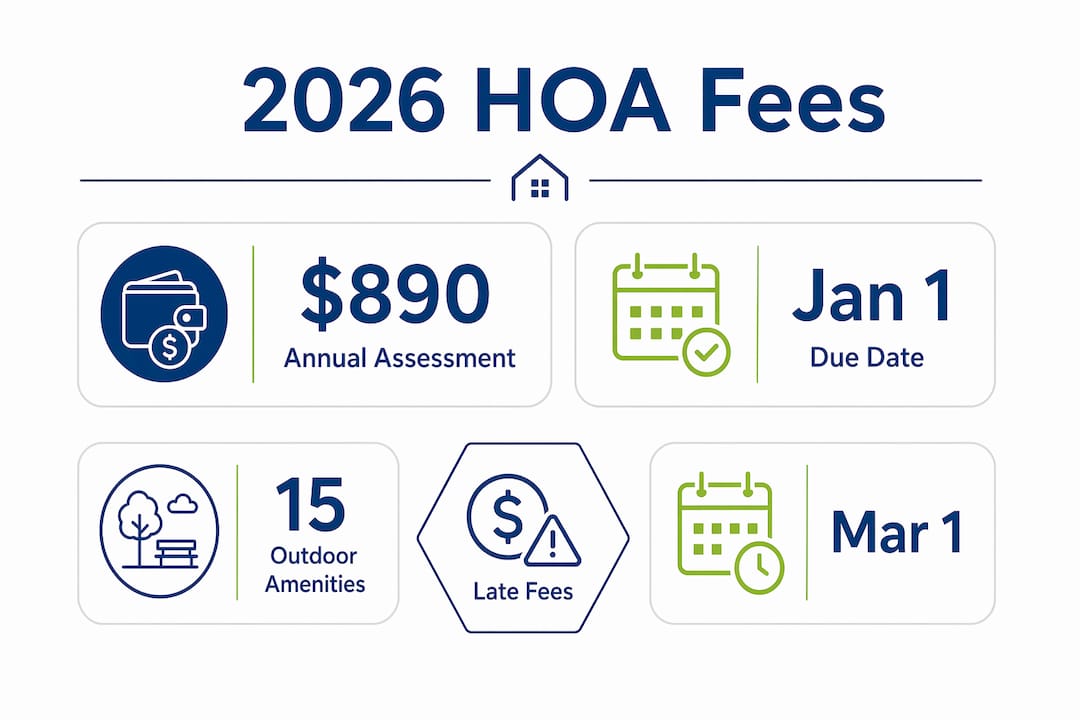
The 2026 annual assessment is set at $890 per property owner. Payment is due january 1, with late fees applied after march 1. That deadline matters because the RA does enforce it, and late fees compound quickly.

The $890 assessment funds a substantial portfolio of shared amenities. Reston Association members get access to 15 outdoor pools, 52 tennis courts, 1,350 acres of open space, and 55 miles of community pathways. That is an unusually rich amenity package for a suburban HOA, and it explains why Reston property values hold up well compared to unmanaged neighborhoods nearby.
| Fee Component | 2026 Detail |
|---|---|
| Annual Assessment | $890 per property owner |
| Payment Due Date | January 1, 2026 |
| Late Fee Trigger | After March 1, 2026 |
| Pools Covered | 15 outdoor pools |
| Tennis Courts | 52 courts community-wide |
| Open Space Maintained | 1,350 acres |
| Pathways | 55 miles of trails |
Residents who qualify under the Fairfax County Tax Relief Program may be eligible for a reduced assessment rate. If you are a senior or disabled homeowner, check your eligibility before the january payment deadline. The savings can be meaningful, and many qualifying residents simply do not know the program exists.
Most standard HOA models in Northern Virginia charge fees that cover only basic maintenance. Reston's assessment covers a far broader scope. That breadth is a genuine selling point when you are comparing neighborhoods.
The Design Review Board (DRB) is the RA body that approves or rejects exterior changes to Reston properties. You must get DRB approval before starting any visible exterior modification, and that requirement applies even to changes that seem minor. The DRB process is not bureaucratic friction for its own sake. It is the mechanism that keeps Reston's visual character consistent across decades of development.
Tree removal is one of the most commonly misunderstood requirements. Removing a live tree with a trunk diameter of approximately 4 inches or greater requires formal approval from the DRB or covenants staff. Replacement with a native species is mandatory. Violations can result in fines, loss of community privileges, or a formal notice recorded in Fairfax County land records. That last consequence is serious because it can surface during a title search when you sell.
For roofing specifically, the DRB has clear material preferences. Earth tone colors like charcoal, slate gray, and weathered wood are the standard. Submissions that align with these preferences move through the approval process faster. Local roofing contractors who work regularly in Reston know this and will steer you toward compliant materials from the start.
Key rules to know before starting any exterior project:
Pro Tip: Request a pre-application consultation with the DRB before submitting formal plans. Many rejections happen because applicants skip this step and submit incomplete packages.
The RA operates a defined complaints and enforcement process with specific timelines. When a violation notice is issued, residents have 10 business days to submit an appeal for Use and Maintenance violations. Missing that window limits your options significantly. Continued non-compliance can escalate to legal action or a notice recorded in county land records.
The process follows a predictable sequence:
Party walls are a separate category that catches many residents off guard. Structural elements on property lines, including shared walls and fences, are jointly maintained by both neighboring property owners. Neither owner can unilaterally repair or modify a party wall without coordinating with the other. Disagreements over cost-sharing are a common source of neighbor disputes in Reston's townhome communities.
The most effective way to avoid enforcement is proactive communication. Contact the RA or your cluster HOA before starting any project, not after a notice arrives. Regular communication between residents and boards consistently reduces friction and prevents misunderstandings from escalating.
Buying a home in Reston without reading the governing documents is a costly mistake. Every Reston property comes with at least two sets of rules: the master RA's covenants and your specific cluster HOA's standards. Both documents are legally binding from the day you close.
Here is a practical checklist for new and prospective Reston homeowners:
Working with a local real estate professional who knows Reston's HOA structure saves time and prevents expensive surprises. An experienced agent will flag cluster-specific restrictions that a general property search will never surface. They will also know which clusters have active enforcement programs and which have pending rule changes that could affect your renovation plans.
Pro Tip: Ask your agent to pull the last 12 months of cluster board meeting minutes before you make an offer. Pending assessments, active disputes, and deferred maintenance projects all show up there.
Homeowners who plan exterior updates after closing should photograph their property thoroughly before any work begins. Those photos serve as a baseline record if a dispute arises about pre-existing conditions. You can also use professional photo documentation tools to create a timestamped visual record of your property's exterior state.
The Reston Association's two-layer HOA structure, combined with a $890 annual assessment and active Design Review Board enforcement, makes early document review and proactive communication the most important steps any Reston homeowner can take.
| Point | Details |
|---|---|
| Two-layer HOA structure | Both master RA and cluster HOA rules apply; the stricter rule always prevails. |
| 2026 annual assessment | $890 per property, due January 1, with late fees after March 1. |
| DRB approval required | Get Design Review Board sign-off before any exterior modification, including tree removal. |
| Appeal window is short | Residents have only 10 business days to appeal a Use and Maintenance violation notice. |
| Read both document sets | Review RA covenants and cluster standards before closing or starting any project. |
Most buyers I work with underestimate the cluster HOA layer. They read the RA documents, feel prepared, and then discover their specific cluster has a standards committee with rules that go well beyond what the master RA requires. That gap between expectation and reality is where most HOA frustrations originate.
The fix is straightforward but requires discipline. You have to treat the cluster HOA as a separate entity with its own culture, enforcement history, and pending decisions. Some clusters in Reston are lightly managed with minimal enforcement. Others have active standards committees that conduct regular inspections. Knowing which type you are buying into changes the calculus of what renovations are realistic.
I also see residents make the mistake of treating HOA meetings as optional. Board meeting attendance gives you direct access to the people making decisions about your neighborhood. It also gives you standing to raise concerns before they become formal disputes. Residents who show up consistently are treated differently than those who only appear when they receive a violation notice.
The property value argument for HOA compliance is real and underappreciated. Reston homes in well-maintained clusters consistently outperform comparable homes in less-managed communities. The $890 annual assessment is not a cost. It is an investment in the conditions that support your home's long-term value.
— Mazin
Understanding Reston's HOA structure is one thing. Applying that knowledge to a real purchase or renovation decision is another. At Herndonhomeguide, we work directly with buyers and sellers navigating the full complexity of Reston's master RA and cluster HOA requirements every day.

Whether you are evaluating a specific cluster's restrictions before making an offer or trying to understand how the 2026 assessment affects your carrying costs, Mazin Abdelhameid provides the local expertise that generic real estate platforms cannot match. Herndonhomeguide connects you with Reston HOA guidance grounded in real transaction experience, not general advice. Reach out directly to get answers specific to the property and cluster you are considering.
The 2026 annual assessment is $890 per property owner, due January 1. Late fees apply after March 1, and qualifying residents may receive a reduced rate through the Fairfax County Tax Relief Program.
Most Reston property owners are automatically members of the Reston Association upon purchase. Many also belong to a cluster HOA, which operates as a separate entity with its own rules and fees.
Submit an application to the Design Review Board before starting any exterior modification. Check both RA guidelines and your cluster HOA standards, since the stricter rule applies when the two conflict.
The RA issues a formal violation notice with a correction deadline. Residents have 10 business days to appeal Use and Maintenance violations. Unresolved violations can escalate to fines or notices recorded in Fairfax County land records.
Removing a live tree with a trunk diameter of approximately 4 inches or greater requires formal DRB or covenants staff approval. Replacement with a native species is required, and unauthorized removal can trigger fines and county land record notices.
A real estate agent coordinates the closing process by managing communication, deadlines, inspections, and paperwork across every party involved in the transaction. This coordination role is
What Does Real Estate Seasonality Mean for Buyers?Real estate seasonality is defined as the predictable annual cycle of fluctuations in buyer demand, home inventory, and prices that repeat at
Reston Homeowners Association: 2026 Resident GuideThe Reston Homeowners Association is the primary community organization governing property standards, amenities, and neighborhood rules for most
Work With a Buyer Agent Effectively in 2026A buyer's agent is defined as a licensed real estate professional who represents the buyer's legal and financial interests throughout the entire purchase
 © BRIGHT, All Rights Reserved
Information Deemed Reliable But Not Guaranteed
The data relating to real estate for sale on this website appears in part through the BRIGHT Internet Data Exchange program, a voluntary cooperative exchange of
property listing data between licensed real estate brokerage firms in which
participates, and is provided by BRIGHT through a licensing agreement.
The information provided by this website is for the personal,
non-commercial use of consumers and may not be used for any purpose other than to identify prospective properties consumers may be interested in purchasing.
Data last updated: September 21, 2026 8:07 AM UTC
Some properties which appear for sale on this website may no longer be available
because they are under contract, have Closed or are no longer being offered for sale.
Some real estate firms do not participate in IDX and their listings do not appear on this website. Some properties listed with participating firms do not appear on this website at the request of the seller.
Show More...
