
A real estate agent coordinates the closing process by managing communication, deadlines, inspections, and paperwork across every party involved in the transaction. This coordination role is

Dated: June 26 2026
Views: 34

Fiduciary duty in real estate is the highest legal standard requiring an agent to place their client's interests above their own in every decision made during a transaction. This obligation, known formally as a fiduciary relationship, is not a handshake agreement or a professional courtesy. It is a legally enforceable duty that arises the moment a formal representation agreement is signed. For buyers and sellers in Northern Virginia and across the country, understanding this standard is the difference between knowing your rights and unknowingly giving them up.
Fiduciary duty is defined as a legal obligation requiring one party, the agent, to act entirely in the best interest of another party, the client. In real estate, this duty is established by state licensing statutes and is actionable in all 50 states if breached. The standard is not about being polite or professional. It is about legal accountability.
The six specific obligations that make up this duty are organized under the acronym OLDCAR: Obedience, Loyalty, Disclosure, Confidentiality, Accounting, and Reasonable Care. Each one carries its own legal weight. Together, they define what your agent is legally required to do on your behalf from the moment you sign a representation agreement to the day the transaction closes.

One critical distinction most clients miss: fiduciary duties apply only to clients, not customers. A buyer who walks into an open house without a signed buyer-representation agreement is a customer, not a client. That agent owes them basic honesty and fair dealing, but not the full fiduciary standard. The fiduciary legal duties are reserved exclusively for those with formal representation agreements.
The OLDCAR framework is the clearest way to understand what your agent is legally bound to do. Each duty is specific, not vague.
Pro Tip: Ask your agent directly at your first meeting: "Are you representing me as a fiduciary?" If they hesitate or redirect the question, that tells you something important about the relationship you are entering.
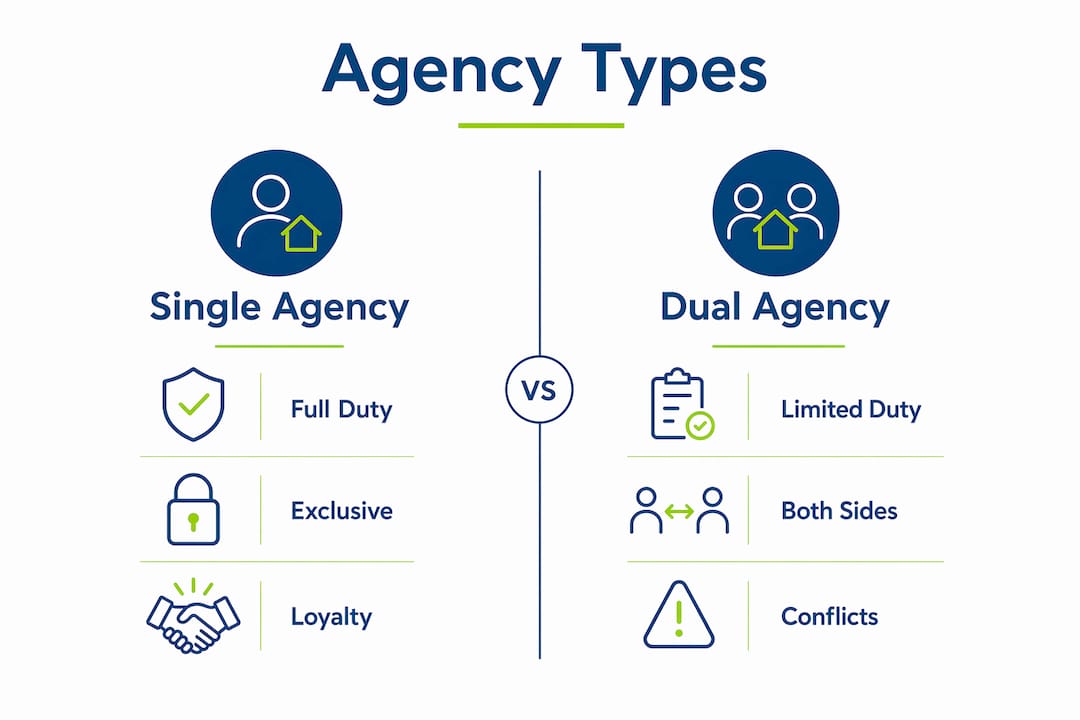
Not all agent relationships carry the same fiduciary weight. The type of agency relationship you enter determines how much protection you actually receive.
| Agency type | Fiduciary scope | Key limitation |
|---|---|---|
| Single agency | Full fiduciary duties to one client | None; agent advocates entirely for you |
| Dual agency | Reduced loyalty and confidentiality | Agent represents both buyer and seller |
| Designated agency | Full duties through separate agents in one brokerage | Depends on brokerage structure and state law |
| Transaction brokerage | Limited duties: honesty, accounting, disclosure | No advocacy; agent is a neutral facilitator |
Single agency is the gold standard. Your agent works exclusively for you, with no competing loyalties. Dual agency is where things get complicated. When one agent represents both the buyer and the seller in the same transaction, dual agency inherently limits fiduciary duties because the agent cannot fully advocate for both sides simultaneously. The agent shifts from zealous advocate to neutral facilitator. Many states require written consent and explicit disclosure before dual agency is permitted.
Designated agency is a middle-ground solution used by larger brokerages. Two separate agents within the same firm each represent one party, theoretically preserving full fiduciary duties. Whether this works in practice depends heavily on the brokerage's internal information barriers.
Transaction brokerage, common in states like Florida and Colorado, removes fiduciary advocacy entirely. The agent facilitates the deal but owes you only honesty, fair dealing, and proper accounting. This is not the same as having a fiduciary in your corner.
Pro Tip: Written agreements define your relationship. Before signing anything, confirm in writing whether your agent is acting as a single agent fiduciary, a dual agent, or a transaction broker. The scope of your rights depends entirely on what that document says.
Breaching fiduciary duty is not a minor professional misstep. The consequences are serious, and they apply across civil, professional, and in extreme cases, criminal channels.
"Breaching fiduciary duty can lead to personal liability, license revocation, disgorgement of profits, and even federal criminal prosecution with prison time." — LegalClarity, 2026
The specific penalties an agent may face include:
Recognizing a breach starts with knowing what your agent is required to do. If your agent is sharing your confidential information with the other party, pushing you toward a deal that benefits them more than you, or failing to disclose known problems with a property, those are red flags worth documenting and reporting.
Knowing your rights is only useful if you act on them. Here is how to make fiduciary duty work for you in a real transaction.
Pro Tip: Keep a written record of every significant conversation with your agent. If a dispute arises, your documentation of what was said, when, and by whom is your most valuable asset. Check real estate disclosure requirements in your state to understand what must be provided in writing.
Fiduciary duty in real estate is a legally enforceable standard requiring agents to act in their clients' best interests across six specific obligations, and its scope depends entirely on the type of agency relationship you formalize in writing.
| Point | Details |
|---|---|
| OLDCAR defines the duty | Six obligations: Obedience, Loyalty, Disclosure, Confidentiality, Accounting, and Reasonable Care. |
| Clients vs. customers | Full fiduciary duties apply only to clients with signed representation agreements, not to unrepresented buyers or sellers. |
| Agency type changes everything | Single agency provides full protection; dual agency and transaction brokerage significantly reduce fiduciary scope. |
| Breaches carry real penalties | Agents face civil liability, profit disgorgement, license revocation, and potential criminal prosecution. |
| Written agreements are your protection | Signing a formal representation agreement is the trigger for all fiduciary obligations to take effect. |
I have worked with buyers and sellers at every stage of the market, and the single most common misunderstanding I encounter is this: people assume their agent is automatically working for them. That assumption is wrong, and it costs people money.
Fiduciary duty is not a formality. It is the legal architecture that separates a true advocate from someone who is simply facilitating a transaction. When I represent a client, the OLDCAR framework is not a checklist I review once. It shapes every conversation, every recommendation, and every piece of information I choose to share or protect.
Dual agency is the situation I advise clients to think hardest about. When one agent represents both sides, the math on loyalty simply does not work. You cannot fully advocate for a buyer getting the lowest price while simultaneously advocating for a seller getting the highest. Something gives. That something is usually your interests.
The fiduciary system exists to protect people who lack expert knowledge from being exploited by those who have it. That is a powerful protection, but only if you activate it by signing the right agreement with the right agent. A representation agreement is not paperwork. It is a legal contract that puts an agent's license on the line if they fail you.
My honest advice: treat the agency conversation as seriously as you treat the purchase contract. Ask who your agent represents, get it in writing, and hold them to it.
— Mazin

At Herndonhomeguide, fiduciary duty is not a talking point. It is the standard Mazin Abdelhameid applies to every buyer and seller he represents in Herndon, Reston, and Great Falls. Every client receives full single-agency representation, complete transparency on disclosures, and an agent who puts your outcome ahead of everything else. If you are buying or selling in Northern Virginia and want to work with an agent who treats your representation agreement as the legal commitment it is, connect directly with Mazin at Herndonhomeguide to start the conversation. Your interests deserve nothing less than the full fiduciary standard.
Fiduciary duty means a real estate agent is legally required to act in their client's best interest above all else, including their own financial gain. This obligation covers six specific duties: Obedience, Loyalty, Disclosure, Confidentiality, Accounting, and Reasonable Care.
Fiduciary duty applies only when a formal representation agreement exists between the agent and the client. Agents owe basic honesty and fair dealing to unrepresented customers, but the full fiduciary standard is reserved for clients with signed agreements.
An agent who breaches fiduciary duty can face civil lawsuits, disgorgement of profits, suspension or revocation of their real estate license, and in cases involving fraud or embezzlement, criminal prosecution and imprisonment.
Yes. Dual agency reduces an agent's fiduciary obligations because representing both buyer and seller creates inherent conflicts of interest. The agent shifts from full advocate to neutral facilitator, which limits loyalty and confidentiality protections for both parties.
Check your signed agreement. If you have a buyer-representation or listing agreement that designates your agent as a single agent, you have full fiduciary protections. If the agreement describes a transaction brokerage or dual agency arrangement, your protections are more limited.
A real estate agent coordinates the closing process by managing communication, deadlines, inspections, and paperwork across every party involved in the transaction. This coordination role is
What Does Real Estate Seasonality Mean for Buyers?Real estate seasonality is defined as the predictable annual cycle of fluctuations in buyer demand, home inventory, and prices that repeat at
Reston Homeowners Association: 2026 Resident GuideThe Reston Homeowners Association is the primary community organization governing property standards, amenities, and neighborhood rules for most
Work With a Buyer Agent Effectively in 2026A buyer's agent is defined as a licensed real estate professional who represents the buyer's legal and financial interests throughout the entire purchase
 © BRIGHT, All Rights Reserved
Information Deemed Reliable But Not Guaranteed
The data relating to real estate for sale on this website appears in part through the BRIGHT Internet Data Exchange program, a voluntary cooperative exchange of
property listing data between licensed real estate brokerage firms in which
participates, and is provided by BRIGHT through a licensing agreement.
The information provided by this website is for the personal,
non-commercial use of consumers and may not be used for any purpose other than to identify prospective properties consumers may be interested in purchasing.
Data last updated: September 21, 2026 8:07 AM UTC
Some properties which appear for sale on this website may no longer be available
because they are under contract, have Closed or are no longer being offered for sale.
Some real estate firms do not participate in IDX and their listings do not appear on this website. Some properties listed with participating firms do not appear on this website at the request of the seller.
Show More...
